Minecraft Mineshaft Finder – Locate Abandoned Mineshafts & Cave Spider Spawners
A minecraft mineshaft finder solves one of the most annoying problems in underground exploration: mineshafts are huge, but they are also invisible from the surface. You can dig for hours, cross three cave systems, and still miss the tunnel network sitting a hundred blocks from your base. Paste your seed into the minecraft mineshaft finder below and every abandoned mineshaft on the map lights up, so you can dig straight down to rails, chests, and cave spider spawners instead of hoping a cave happens to intersect one.
A mineshaft needs caves around it to matter. cave systems that swallow whole mountains deliver the whole underground system – shafts, dungeons and dripstone caverns included.
Try These Seeds in the Seed Map
Mineshafts are worth hunting because they are the densest loot structures underground. Minecart chests hold diamonds, enchanted golden apples, name tags, and saddle loot, and the rails themselves give you a ready-made transport network. They are also the only place cave spider spawners generate – the key ingredient in some of the best XP and string farms in the game.
What Is a Minecraft Mineshaft Finder?
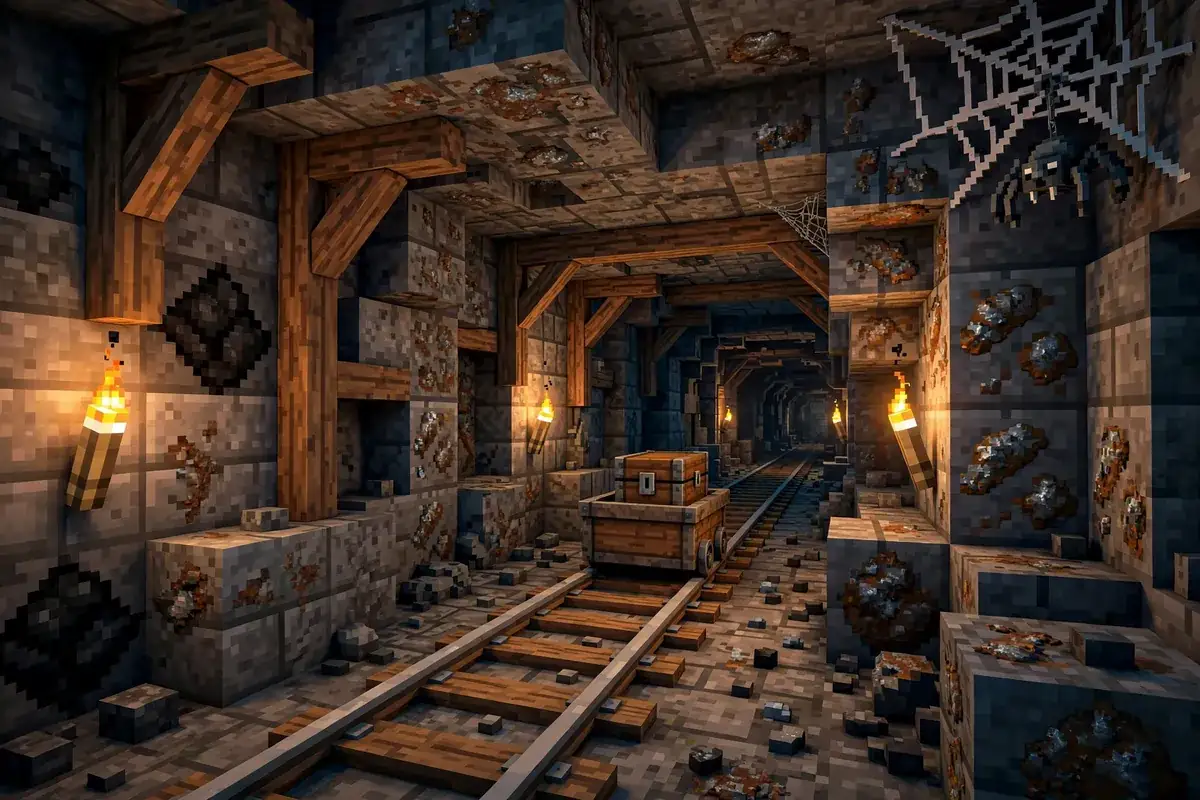
A minecraft mineshaft finder reads your world seed and calculates where every abandoned mineshaft generates, then plots each one on a map with coordinates. An abandoned mineshaft is a sprawling underground network of tunnels, wooden supports, rails, and minecart chests that generates deep below the surface, usually between the deep slate layers and the mid-underground. Because mineshaft placement is decided by the seed, the same seed always produces the same tunnels in the same places – so the map is exact.
In the minecraft mineshaft finder, the Mineshaft layer shows each mineshaft’s position on the seed map. Enter your seed, pick your edition and version, and turn the layer on in the Layers panel. The tool covers Java 1.7–“26.3 and Bedrock Beta 1.7–“26.60 with the real generator for each edition. One honest note: the marker shows where the mineshaft structure starts. Mineshaft tunnels sprawl hundreds of blocks from that point, so dig down at the marker and then follow the tunnels – the whole network fans out around it.
How to Use the Minecraft Mineshaft Finder
- Paste your seed – Enter your world seed in the seed box on the seed map.
- Match your edition and version – Choose Java or Bedrock and your exact game version, since mineshaft placement differs between editions.
- Turn on the Mineshaft layer – Open the Layers panel and switch on Mineshaft. It is off by default because mineshaft markers are most useful once you have zoomed in.
- Zoom to your base area in the minecraft mineshaft finder – Mineshafts are underground, so zoom in until the map shows your base or spawn region clearly, then look for mineshaft markers nearby.
- Search for new seeds – Click Find seeds, then Add condition, choose Structure → Mineshaft, and set a radius. Click Search for up to 100 seeds with a mineshaft where you want it.
- Dig to the marker – Head to the coordinates, dig a safe shaft with a water bucket or staircase, and follow the tunnels once you break through.
- Share the location – Use the share menu to Copy link, Save PNG of the map, or export a 4K poster for your group.
If you are used to the chunkbase mineshaft finder, the workflow here will feel familiar: paste a seed, see mineshafts. The difference is that you can also run a fresh seed search for mineshafts near spawn, and you can stack a mineshaft condition with a biome or village condition to find a base location with an underground network already waiting.
What You Will Find Inside an Abandoned Mineshaft
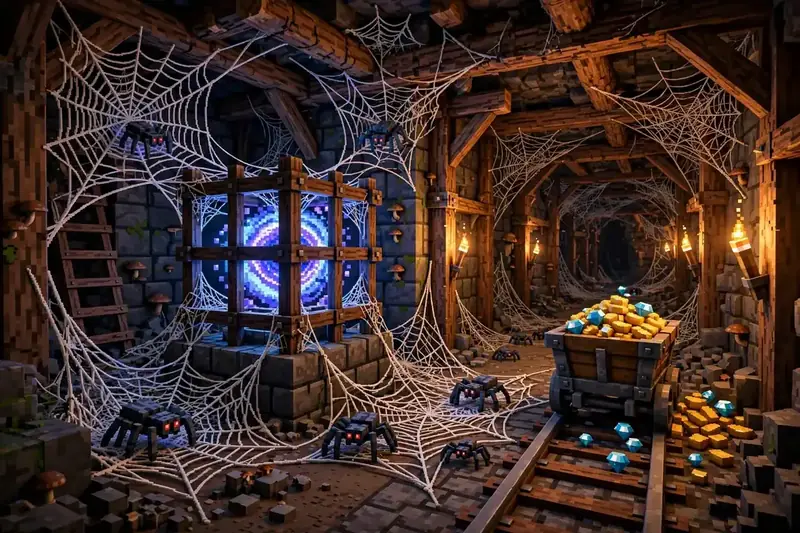
Mineshafts are not a single room – they are networks, and the minecraft mineshaft finder shows you where each network starts. A big one can cover an area larger than a village. Expect to find:
| Feature | What it means for you |
|---|---|
| Minecart chests | Loot chests on rails: diamonds, gold ingots, iron, lapis, name tags, saddles, enchanted books |
| Cave spider spawners | The only cave spider spawners in the game – the core of XP and string farms |
| Rails and powered rails | Free rail lines you can harvest or ride once you clear the tunnels |
| Wooden supports and fences | Oak fences and planks – harvestable wood without going back to the surface |
| Ore exposure | Tunnels cut through stone, exposing coal, iron, gold, and diamond veins along the walls |
The minecart chests are the headline loot. Their loot table includes diamonds, enchanted golden apples, and name tags – items that are slow to farm any other way. Minecart chests are also one of the few sources of melon seeds and pumpkin seeds, alongside jungle temples – worth grabbing even on a farm-focused run. Cave spider spawners are the long-term prize: box one in, build a standard spawner farm around it, and you have renewable XP, string, and spider eyes for the rest of the world. Bring shears too: cobwebs cut with shears drop as string.
Mineshafts, Caves, and the Best Way to Explore Them
Mineshafts generate intersecting with caves, which is both the opportunity and the danger. A cave gives you easy access to a mineshaft without digging, but mineshaft tunnels also open into cave drops, lava pools, and skeleton spawners. Go in with torches, a water bucket, food, and a shield. Light as you go: mineshafts are dark, and cave spiders are fast, poisonous, and spawn in groups around their spawners.
One exception is worth knowing: in badlands (mesa) biomes, mineshafts generate at the surface instead of underground, built from dark oak rather than oak, and clearly visible among the terracotta. They are the easiest mineshafts to find without any tool – just visit a badlands biome. A minecraft mineshaft finder check on a badlands seed shows the surface shafts before you ever set foot in the terracotta. Everywhere else, mineshafts sit underground, roughly from Y -64 up to Y 0, while badlands shafts can run from Y 32 up to Y 256.
The best mineshaft seeds are the ones where the tunnels sit under a base you actually want to live in. A best minecraft seeds abandoned mineshaft search is really a search for convenience – a mineshaft within a few hundred blocks of spawn, ideally under plains or a forest where building a base is easy. Use the minecraft mineshaft finder seed search with a Mineshaft condition at a 300–“500 block radius, and pair it with a biome condition for your preferred surface. A minecraft seed map mineshaft check on a world you already play works the same way: paste the seed, find the nearest marker, and dig.
A chunkbase mineshaft finder result for the same seed shows the same tunnel starts; use whichever map you have open, then dig at the marker.
Mineshafts also pair well with other underground targets. If you are hunting diamonds, check the Minecraft diamond finder and Minecraft ore finder pages for the best depths in your version, then plan a mining route that passes through the mineshaft tunnels – the exposed ores along tunnel walls are free pickings. For a surface base above your mineshaft, the Minecraft village finder and Minecraft biome finder help you pick the spot.
Mineshaft Finder for Bedrock
In the minecraft mineshaft finder, Bedrock mineshafts generate through the real Bedrock generator in this tool, not a Java approximation. A minecraft bedrock seeds mineshaft search therefore returns genuine Bedrock coordinates. Paste your Bedrock seed, switch the edition dropdown to Bedrock, and pick your version. The mineshaft markers update to match Bedrock generation, and the seed search works the same way – add a Mineshaft condition and search.
Like a chunkbase mineshaft finder check on Bedrock, the result depends on the exact version – match it before you dig.
One Bedrock quirk worth knowing: mineshaft generation rules have changed across versions, so always match the exact version you play on. A mineshaft that exists in 1.21 may sit somewhere else in an older Bedrock build. The version dropdown covers Bedrock Beta 1.7 through 26.60, so pick the one that matches your world.
Chunkbase Mineshaft Finder vs This Tool
A chunkbase mineshaft finder search and this tool work the same way at first: paste a seed, see mineshaft markers. The difference is the search. A chunkbase mineshaft finder check tells you where the mineshafts are in a seed you already have; this tool also runs fresh seed searches, so you can ask for a mineshaft within a few hundred blocks of spawn and stack a biome condition for the surface you want to live on. For a world you already play, either map finds the tunnels – the marker shows the same starting point, and the digging is up to you either way.
Mineshaft Finder vs Exploring Blind
The in-game alternative is digging and hoping. There is no /locate shortcut that shows you every mineshaft at once – the command finds one structure at a time, needs cheats, and gives you no sense of how the tunnels sprawl. (/locate structure minecraft:mineshaft finds the nearest one; badlands surface shafts have their own mineshaft_mesa variant.) The minecraft mineshaft finder shows the full picture: every mineshaft near your base, its distance from spawn, and the terrain above it. For an existing survival world without cheats, pasting the seed is the only practical way to map your underground.
When you are done underground, pair the minecraft mineshaft finder with the full set of tools on the finders hub, and the Minecraft seed finder can search for mineshaft seeds from scratch. Prefer a ready-made world? The best Minecraft seeds collection includes survival-friendly spawns worth checking for mineshafts underneath.
Final Thoughts
Mineshafts reward players who dig with a destination. A marker, a safe shaft, and a plan for the tunnels beats hours of blind caving – and the chests and spawners you find along the way pay for the trip many times over.
If you came here from a chunkbase mineshaft finder search, the map will feel familiar – paste a seed, see the tunnel starts – with the seed search as the extra step for new worlds. Open the seed map, match your version, and try the minecraft mineshaft finder on your own world: find the nearest marker, dig a safe shaft, and follow the rails.